SWEAT GLANDS

SWEAT GLANDS: THE SCIENCE BEHIND BODY ODOUR

Sweat Isn’t the Problem

One of the biggest misconceptions about body odour is that sweat itself smells bad.

In reality, freshly produced sweat is almost odorless. Body odour develops when naturally occurring skin bacteria break down components of sweat into volatile compounds, including sulphur-containing molecules and short-chain fatty acids.

The Two Main Types of Sweat Glands

1. Eccrine Sweat Glands

Found almost everywhere on the body

Approximately 2–4 million eccrine sweat glands are distributed across human skin.

Primary Function

• Regulate body temperature
• Cool the body through evaporation
• Maintain normal skin hydration

Sweat Composition

Mostly:

• Water (~99%)
• Sodium
• Potassium
• Chloride
• Small amounts of urea, lactate and minerals

Fresh eccrine sweat is virtually odorless.

Mainly located in:

• Underarms (Axillae)
• Around the nipples
• Groin region

These glands become active after puberty.

Sweat Composition

Unlike eccrine sweat, apocrine sweat contains:

• Lipids
• Proteins
• Amino acid derivatives
• Steroid-like compounds

Although freshly secreted apocrine sweat is also nearly odorless, these compounds become food for naturally occurring skin bacteria, which transform them into odour-active molecules.

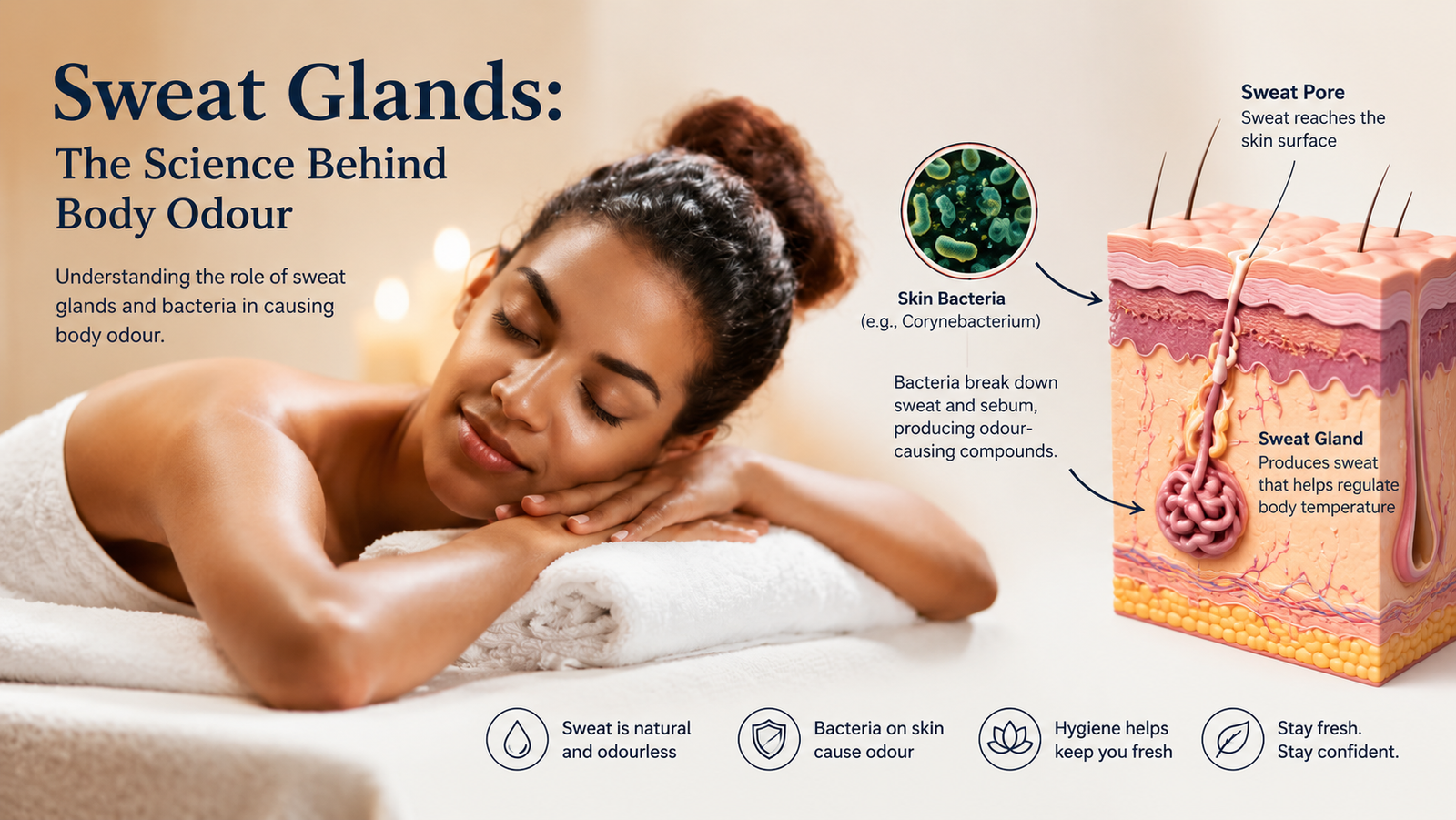
How Body Odour Forms

Apocrine Sweat

Skin Microbiome

Bacterial Metabolism

Sulphur Compounds + Short-Chain Fatty Acids + Other Volatile Molecules

Body Odour

This is why sweating alone does not necessarily cause body odour.


Sweat Is Essential for Health

Sweating is one of the body’s most important physiological processes.

It helps:

• Regulate body temperature
• Prevent overheating
• Support exercise performance
• Maintain normal skin function